
Contents
Dental Implant Cost 2026: Full Price Breakdown (With & Without Insurance)
A single dental implant costs $3,000 to $6,000 in the United States in 2026. That price covers the three components of a complete implant: the titanium post ($1,000 to $2,000), the abutment ($400 to $1,000), and the crown ($1,000 to $2,500). Full mouth restorations run $14,000 to $36,000 per arch, and most patients pay around $4,500 for a complete single tooth implant.
Your final bill depends on where you live, which materials you choose, and whether you need preparatory work like an extraction or a bone graft. This guide breaks down every cost line, shows what insurance actually pays, and lists the proven ways to cut the total by 30 to 50 percent.
2026 Price Update
Dental implant costs have increased approximately 4 to 6 percent since 2024, driven primarily by rising titanium and zirconia material costs, increased lab fees for custom prosthetics, and higher overhead for dental practices. However, expanded insurance coverage and new financing options have made implants more accessible than ever.
What a Dental Implant Costs, Component by Component
A "dental implant" is not one item. It is three parts placed over 3 to 6 months, plus imaging and surgery fees. Some clinics quote only the post. Always ask for the all-in price.
| Component | What it is | Cost 2026 |
|---|---|---|
| Implant post | Titanium root placed in the jawbone | $1,000 to $2,000 |
| Abutment | Connector between post and crown | $400 to $1,000 |
| Crown | The visible tooth | $1,000 to $2,500 |
| Consultation + CBCT scan | 3D imaging and treatment plan | $200 to $500 |
| Complete single implant | All components included | $3,000 to $6,000 |
The Three Components of an Implant
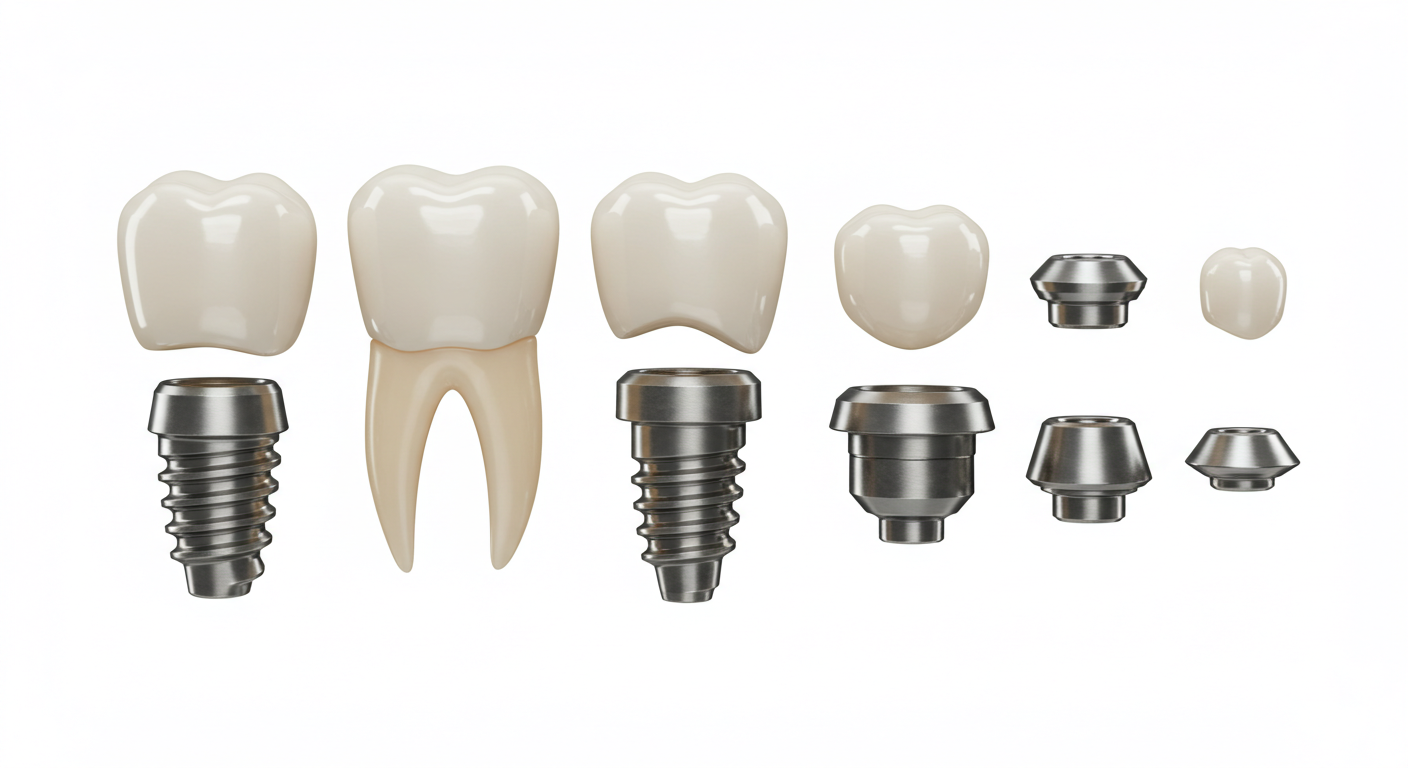
- The implant post (fixture): A small screw made of titanium or zirconia that is surgically placed into the jawbone. It serves as the artificial tooth root. This is the most technically demanding and costly component.
- The abutment: A connector piece that attaches to the top of the implant post and protrudes through the gum line. It can be prefabricated (stock) or custom-milled for optimal aesthetics.
- The crown (prosthesis): The visible artificial tooth that attaches to the abutment. Made from porcelain, zirconia, or porcelain-fused-to-metal. Custom-designed to match your natural teeth in color, shape, and size.
Additional Procedures That Raise the Total
Not every patient needs these. Your dentist confirms after the CBCT scan.
| Procedure | When you need it | Cost 2026 |
|---|---|---|
| Tooth extraction | The damaged tooth is still in place | $150 to $400 |
| Bone grafting | The jawbone is too thin to hold the post | $500 to $3,000 |
| Sinus lift | Upper back implants with low sinus floor | $1,500 to $5,000 |
| Sedation | Patient comfort during surgery | $250 to $1,500 |
One more line shows up on some quotes: a temporary crown or provisional prosthesis worn during the 3 to 6 month healing period, at $200 to $600. Ask whether it is included before you compare two treatment plans, because a practice that bundles it will look more expensive than one that bills it later.
Single Implant Cost Breakdown for 2026
The following table provides the most current cost breakdown for a single dental implant in the United States in 2026:
| Component | Low Estimate | Average | High Estimate |
|---|---|---|---|
| Consultation + CBCT Scan | $200 | $350 | $500 |
| Tooth Extraction | $150 | $275 | $400 |
| Bone Graft (socket preservation) | $500 | $900 | $1,500 |
| Implant Post (Titanium) | $1,000 | $1,500 | $2,000 |
| Implant Post (Zirconia) | $1,500 | $2,200 | $3,000 |
| Custom Abutment | $400 | $700 | $1,000 |
| Porcelain/Zirconia Crown | $1,000 | $1,750 | $2,500 |
| TOTAL (complete single implant, no preparatory work) | $3,000 | $4,500 | $6,000 |
| TOTAL (with extraction + bone graft) | $3,650 | $5,675 | $7,900 |
How to Read the Total Row
The complete implant total is the all-in price patients actually pay, not a strict sum of the column above it. Practices that use the cheapest post rarely pair it with the cheapest crown, and the low end of every single line almost never lands on the same quote. Treat $3,000 to $6,000 as the working envelope and the individual lines as the way to check whether a quote is itemised honestly.
"When patients see the total price of an implant, they often experience sticker shock. But it is essential to contextualize the cost. A well-placed implant from a qualified provider using a reputable implant system should last 25 years or more, often a lifetime. When you amortize $5,000 over 25 years, you are paying $200 per year, or about $17 per month, for a permanent tooth that functions exactly like a natural one."
-- Dr. Arun Garg, DMD, Founder of Implant Seminars and Clinical Professor at Nova Southeastern University
Single Tooth vs. Full Mouth: The Full Price Grid
For patients replacing several teeth or an entire arch, the price depends far more on the restoration design than on the number of implants alone:
| Treatment | What you get | Cost 2026 |
|---|---|---|
| Single tooth implant | 1 post, 1 abutment, 1 crown | $3,000 to $6,000 |
| Implant-supported bridge | 2 implants holding 3 to 4 teeth | $5,000 to $16,000 |
| All-on-4 (per arch) | 4 implants holding a full fixed arch | $14,000 to $30,000 |
| All-on-6 (per arch) | 6 implants, often zirconia arch | $24,000 to $36,000 |
| Snap-in implant denture (per arch) | 2 to 6 implants, removable denture | $8,000 to $18,000 |
| Full mouth, both arches | Complete restoration | $35,000 to $70,000+ |
All-on-4 with an acrylic arch sits at the low end. All-on-6 with zirconia sits at the high end. The material of the final arch drives most of the spread.
Two design notes are worth knowing before you compare quotes. A full fixed arch on four implants is the most cost-effective route for a patient missing every tooth in one jaw, because it replaces ten or more teeth without paying for ten separate implants. And a snap-in denture is removable for cleaning: it is far more stable than a conventional denture, but it is not the same product as a fixed arch, so a quote that is thousands cheaper may simply be quoting the removable option.
Why Dental Implants Cost What They Do
The price of dental implants reflects a combination of factors that distinguish them from simpler dental procedures:
Material Costs
The implant fixture itself is manufactured from medical-grade titanium alloy (Ti-6Al-4V) or yttria-stabilized zirconia, both of which undergo extensive machining, surface treatment, sterilization, and quality testing. A single implant fixture costs the dental practice $200 to $500 at wholesale, depending on the manufacturer and system. Premium implant systems (Nobel Biocare, Straumann, Dentsply Sirona) command higher prices due to decades of clinical research, proprietary surface technologies, and comprehensive warranty programs.
Provider Training and Expertise
Placing dental implants requires advanced training beyond dental school. Most implant providers have completed additional years of education in oral surgery, periodontics, or prosthodontics, representing an investment of $200,000 to $500,000 in post-graduate education. This expertise is reflected in their fees.
Technology and Equipment
Modern implant practices invest heavily in technology: CBCT scanners ($80,000 - $250,000), guided surgery software ($15,000 - $50,000 annually), surgical motor systems ($5,000 - $15,000), and in-house CAD/CAM milling equipment ($100,000 - $300,000). These investments improve outcomes and patient experience but must be amortized across procedures.
Lab Fees
Custom abutments and crowns are fabricated by specialized dental laboratories. A custom zirconia crown with hand-stacked porcelain from a premium U.S. lab costs the dentist $300 to $700. In-house milling with CAD/CAM technology is reducing some of these costs, but the equipment investment offsets the savings.
Dental Implant Cost by State
Location changes the bill by 30 to 50 percent. Pricing surveys in 2026 show a clear split between high-cost metros and lower-cost states. Typical all-in ranges for a complete single implant:
| State group | Examples | Single implant cost 2026 |
|---|---|---|
| High-cost metros | New York, California, Massachusetts, Washington DC | $4,000 to $7,000 |
| Upper mid-range | New Jersey, Illinois, Washington, Colorado | $3,500 to $6,000 |
| Lower-cost states | Texas, Florida, Arizona, Ohio, Georgia | $2,800 to $4,500 |
| Rural and small metro areas | Midwest and South outside major cities | $2,500 to $4,000 |
These ranges sit around the $3,000 to $6,000 national envelope rather than replacing it: dense coastal metros push above the top of it, rural practices fall below the bottom. Within a single state, the spread follows the same logic at city level:
- New York City / Manhattan: $4,500 - $7,000 per single implant
- San Francisco / Bay Area: $4,300 - $6,800 per single implant
- Los Angeles: $4,000 - $6,500 per single implant
- Chicago: $3,700 - $6,000 per single implant
- Dallas / Houston: $3,000 - $4,500 per single implant
- Atlanta: $2,900 - $4,500 per single implant
- Rural Midwest / South: $2,500 - $4,000 per single implant
The dentist's specialty also matters. An oral surgeon or periodontist charges more than a general dentist, but brings more implant-specific training. Ask any provider how many implants they place per year.
How to Read These Ranges
These are indicative ranges built from the 2026 national consensus modulated by regional practice costs, not a measured state-by-state survey. Use them to sanity-check a quote, not as a quote. Your own price depends on the amount of preparatory work, the implant system used and the individual practice. Collect two or three local estimates before you commit.
Dental Implant Costs Around the World
Dental tourism has grown substantially as patients seek lower-cost implant treatment abroad. Here is how prices compare internationally for a single implant with abutment and crown in 2026:
| Country | Average Cost (Single Implant) | Savings vs. U.S. Average | Key Considerations |
|---|---|---|---|
| United States | $3,000 - $6,000 | Baseline | Insurance may cover portion; easy follow-up |
| Mexico | $900 - $2,200 | 50-70% | Proximity to U.S.; wide quality range between clinics |
| Costa Rica | $1,000 - $2,000 | 55-65% | Strong dental tourism infrastructure; English widely spoken |
| Colombia | $800 - $1,800 | 60-75% | Growing medical tourism sector; reputable clinics in Bogota/Medellin |
| Turkey | $600 - $1,500 | 65-80% | Major dental tourism hub; all-inclusive packages common |
| Thailand | $1,200 - $2,500 | 45-65% | JCI-accredited hospitals; excellent quality at top clinics |
| Hungary | $1,000 - $2,000 | 55-70% | Top European dental tourism destination; EU quality standards |
Dental Tourism Warning
While dental tourism can offer genuine savings, it carries real risks. Complications after returning home can be expensive to address locally. Follow-up appointments may require additional international trips. Some overseas clinics use lower-quality implant systems with limited long-term data. Always verify the clinic's accreditation, the implant brand used, and the surgeon's credentials before committing. Request references from previous international patients.
Does Insurance Cover Dental Implants?
Coverage improved in recent years, but it is still partial.
Most PPO dental plans now cover 50 percent of implant costs after your deductible, capped by an annual maximum of $1,500 to $2,500. Roughly 78 percent of PPO dental insurance plans include implants at that level in 2026, up sharply from a decade ago when most classified them as cosmetic. On a $4,500 implant, that means insurance typically pays $1,500 to $2,250 and you pay the rest out of pocket.
Three points to check on your plan:
- Annual maximum. The cap applies to all dental work that year, not just the implant. If you already used benefits, less remains for the implant. Orthodontic work is the exception: braces and Invisalign usually run on a separate lifetime orthodontic maximum rather than the annual cap.
- Missing tooth clause. Many plans exclude teeth lost before the policy started. Read this line before you enroll.
- Medical insurance crossover. If you lost the tooth in an accident or from a covered medical condition, your health insurance may pay part of the surgery.
Original Medicare does not cover implants. Some Medicare Advantage plans include dental benefits that partially apply. Veterans may qualify through VA dental care depending on eligibility class. Our dental implant insurance guide walks through plan wording, pre-authorization and the documents to send with a claim.
Implant, Bridge or Denture: Cost vs. Value
The implant costs the most upfront and the least over a lifetime. It is the only option that replaces the tooth root and preserves the jawbone. Here is how the three options compare over 20 years:
| Criteria | Dental implant | Traditional bridge | Removable partial denture |
|---|---|---|---|
| Upfront cost | $3,000 to $6,000 | $2,000 to $5,000 | $800 to $2,500 |
| Average lifespan | 20+ years (post is often lifelong) | 10 to 15 years | 5 to 8 years |
| Replacements in 20 years | 0-1 (crown only) | 1-2 complete replacements | 2-4 replacements |
| 20-Year Total Cost | $3,000 - $8,000 | $4,000 - $15,000 | $2,000 - $10,000 |
| Long-term cost | Lowest per year of use | Replacement needed | Frequent relines and replacement |
| Bone preservation | Yes (stimulates bone) | No (bone resorbs under pontic) | No (accelerates bone loss) |
| Adjacent teeth | Untouched | Ground down for crowns | Clasps rest on them |
| Success Rate | 95-98% | 90-95% at 10 years | N/A (prosthetic device) |
"I have been placing implants for over 30 years, and the implants I placed in the 1990s are still functioning perfectly in many of my patients. When a patient asks me if implants are worth the money, I point out that a $5,000 implant that lasts 30 years costs $167 per year. A $3,000 bridge that needs replacement every 10 years costs $300 per year. The implant is actually the more economical choice when you think long-term."
-- Dr. Carl Misch (paraphrased), Pioneer of Modern Implant Dentistry, Author of Contemporary Implant Dentistry
If budget rules out an implant today, a bridge or partial denture restores function now. You can place an implant later, though bone loss over time may require grafting. Discuss the timeline with your dentist before choosing.
6 Ways to Pay Less for Dental Implants
Implants are a significant investment, but several legitimate levers cut the out-of-pocket total without sacrificing quality. They stack: most patients who pay well below the national range have combined three or four of them.
- Dental schools. Supervised students place implants for 30 to 50 percent less than private practice. Appointments run longer, quality stays high. There are 72 accredited dental schools in the U.S. as of 2026, and residents work under the direct supervision of experienced faculty.
- Dental discount plans. Membership plans cut 20 to 30 percent at participating dentists, with no waiting period. They are not insurance, so no annual maximum applies.
- HSA or FSA funds. Implants are a qualified medical expense. Paying with pre-tax dollars saves your marginal tax rate.
- Financing. Medical credit cards and in-house payment plans spread the cost over 6 to 24 months, often interest-free if paid on schedule. See our complete dental financing guide for detailed comparisons.
- Cash discount. Many private practices take 10 to 15 percent off a treatment plan paid upfront. Ask directly.
- Get a second quote. Component-level quotes vary widely between providers in the same city. Two consultations often reveal a four-figure difference.
Split Treatment Across Two Benefit Years
An implant is placed in stages over 3 to 6 months, which creates an opening most patients miss. Schedule the extraction and the implant surgery late in one benefit year, and the abutment and crown early in the next. Each stage draws on a separate annual maximum, so a plan capped at $2,000 a year can contribute up to $4,000 to the same tooth. Confirm the timing with both the practice and the insurer before you book, because the claim date is the date of service, not the date the treatment plan was written.
What to Compare in Each Quote
Prices for the same procedure can vary by 50 to 100 percent between practices in the same city, so a quote is only useful next to another quote for the same scope. Get estimates from at least three providers, including a periodontist, an oral surgeon, and a general dentist with implant training. On each one, check five things:
- The implant brand and model, not just "titanium implant".
- The crown material and whether the abutment is stock or custom.
- Whether the CBCT scan and the surgical guide are included.
- Whether a temporary tooth is provided during healing.
- What happens, and what it costs, if the implant fails to integrate.
Smart Savings Strategy
Combine multiple cost-reduction strategies for maximum savings. For example: get treatment at a dental school (up to 50% savings), use your insurance benefits ($1,500 - $2,250 covered), pay the remaining balance with HSA funds (saving 25-35% in taxes), and split treatment across benefit years. This combination can reduce your effective out-of-pocket cost by 70 to 80 percent compared to full retail price at a private practice.
When to Talk to a Dentist
Only a clinical exam with 3D imaging can price your case. Book a consultation if a tooth is missing, loose, or scheduled for extraction. Early implant placement usually avoids the bone grafting that waiting makes necessary, and skipping the graft saves $500 to $3,000 on its own.
FAQ on Dental Implant Costs
Without insurance, a complete single implant costs $3,000 to $6,000 in 2026. With a typical PPO plan covering 50 percent up to the annual maximum, out-of-pocket cost usually lands between $2,000 and $4,000.
Most PPO plans pay 50 percent of the cost after your deductible, limited by an annual maximum of $1,500 to $2,500. On a $4,500 implant, expect insurance to contribute $1,500 to $2,250 at best.
For most patients, yes. An implant lasts 20 years or more, protects the jawbone, and leaves neighboring teeth untouched. A bridge costs less upfront but requires grinding down two healthy teeth and needs replacement within 10 to 15 years.
A removable partial denture is the cheapest option at $800 to $2,500. A bridge comes next, then the implant. The implant costs the least per year of use because it lasts the longest.
The price reflects medical-grade titanium, 3D imaging and surgical planning, specialist training, custom crown fabrication in a lab, and 3 to 6 months of appointments. Each component carries its own material and expertise cost.
Original Medicare does not cover dental implants. Some Medicare Advantage plans include dental benefits that apply partially. Check the plan's dental annex before enrolling.
Price variation reflects differences in geographic location (Manhattan vs. rural Texas), the implant brand used (premium Nobel Biocare vs. economy brands), the provider's level of training and experience, the type and quality of crown material, whether guided surgery is used, and what is included in the quoted price. Some quotes include everything from extraction to final crown, while others quote only the implant post with additional fees for everything else. Always request an itemized treatment plan that lists every component and its cost.
A significantly below-market price should raise questions, not necessarily alarm. Sometimes lower prices reflect a less expensive implant brand, which may have less long-term clinical data but is not inherently unsafe. Other times, the low price is a "bait-and-switch" marketing tactic that excludes essential components (abutment, crown, bone graft). Ask specifically: What implant brand and model? What is included in the price? What is your success rate? What happens if the implant fails? Be especially cautious of prices below $1,500 for a complete single implant (post + abutment + crown) in the U.S., as this is well below material and labor costs.
Not always. If you have adequate bone volume and density (determined by a CBCT scan), no grafting is needed and the implant can be placed directly. Approximately 40 to 60 percent of implant patients require some form of grafting, with costs ranging from $500 for a simple socket preservation graft to $3,000 or more for an extensive block graft. Immediate implant placement at the time of extraction can sometimes avoid the need for a separate grafting procedure, saving both time and money.
Titanium implants have over 50 years of clinical data and remain the standard of care with success rates above 97 percent. Zirconia (ceramic) implants are a newer option that offers superior aesthetics (no gray metal showing through thin gum tissue) and is preferred by patients with titanium sensitivities or those seeking a completely metal-free solution. Zirconia implants cost approximately $500 to $1,000 more than titanium per implant. While zirconia's medium-term data (10-15 years) is very positive, it does not yet have the 30+ year track record of titanium. Both are excellent choices for most patients.
Mini dental implants (MDIs) are narrower than standard implants (1.8-3.3mm vs. 3.5-6mm diameter) and cost $500 to $1,500 per implant, roughly 50 to 70 percent less than standard implants. They are primarily used to stabilize lower dentures and can often be placed without bone grafting due to their smaller size. However, MDIs are not suitable for individual tooth replacement in most cases and have higher failure rates than standard implants, particularly in the upper jaw. They are best viewed as an affordable option specifically for denture stabilization rather than a general replacement for standard implants.
Sources
- American Academy of Implant Dentistry. Dental Implant Fee Survey 2025-2026. AAID; 2026.
- Gaviria L, Salcido JP, Guda T, Ong JL. Current trends in dental implants. Journal of the Korean Association of Oral and Maxillofacial Surgeons. 2024;50(2):68-79.
- Garg A. Dental Implant Pricing and Value: A Comprehensive Analysis for Patients and Providers. Implant Dentistry. 2025;34(3):189-198.
- Misch CE. Contemporary Implant Dentistry. 4th ed. Elsevier; 2020.
- National Association of Dental Plans. Dental Implant Coverage Trends 2020-2026. NADP; 2026.
- Patients Beyond Borders. Dental Tourism Price Comparison Index 2026. PBB; 2026.
- Pjetursson BE, Asgeirsson AG, Zwahlen M, 35th al. Improvements in implant dentistry over the last decade. Journal of Clinical Periodontology. 2025;52(Suppl 26):218-238.