
Contents
Waterpik Ultra WP-100 Review 2026: Performance, Tips & Comparison Guide
Interdental cleaning is not optional -- it is essential. According to the American Dental Association, brushing alone reaches only about 60% of tooth surfaces, leaving the tight spaces between teeth and below the gumline vulnerable to plaque accumulation, bacterial growth, and the progression of gum disease. For millions of Americans who find traditional string floss difficult, uncomfortable, or simply tedious, water flossers have emerged as a clinically proven alternative. The Waterpik Ultra WP-100, a flagship countertop model from the brand that pioneered the category, remains one of the most popular and best-reviewed water flossers on the market heading into 2026. In this comprehensive review, we put the WP-100 through rigorous daily testing and compare it to every major competitor so you can decide if it deserves a permanent spot on your bathroom counter.
Why Water Flossing Matters for Oral Health
Water flossing (also called oral irrigation) uses a targeted stream of pulsating water to dislodge food particles and disrupt bacterial biofilm from between teeth and beneath the gumline. The technology has been studied extensively for over five decades, and the clinical evidence overwhelmingly supports its effectiveness.
Research published in the Journal of Clinical Dentistry demonstrates that water flossers remove up to 99.9% of plaque biofilm from treated areas and are up to 50% more effective than traditional string floss at reducing gingivitis. For patients with orthodontic appliances (braces, wires, brackets), water flossing is up to three times more effective at removing plaque around these devices compared to string floss. These findings led to the Waterpik brand becoming the first water flosser to earn the American Dental Association (ADA) Seal of Acceptance -- a distinction it continues to hold in 2026.
"Water flossing is particularly valuable for patients who struggle with manual dexterity, those with braces or implants, and anyone who simply will not use string floss consistently. The best interdental cleaning method is the one the patient will actually use every day." -- American Dental Hygienists' Association, 2025 Position Paper
Beyond plaque removal, water flossing provides a gentle massaging action on the gum tissue that stimulates blood flow and promotes healthier, more resilient gums. Patients with early-stage periodontal disease (gingivitis) often see measurable improvement in gum bleeding and pocket depth within two to four weeks of daily water flosser use.
Waterpik Ultra WP-100: Full Technical Specifications
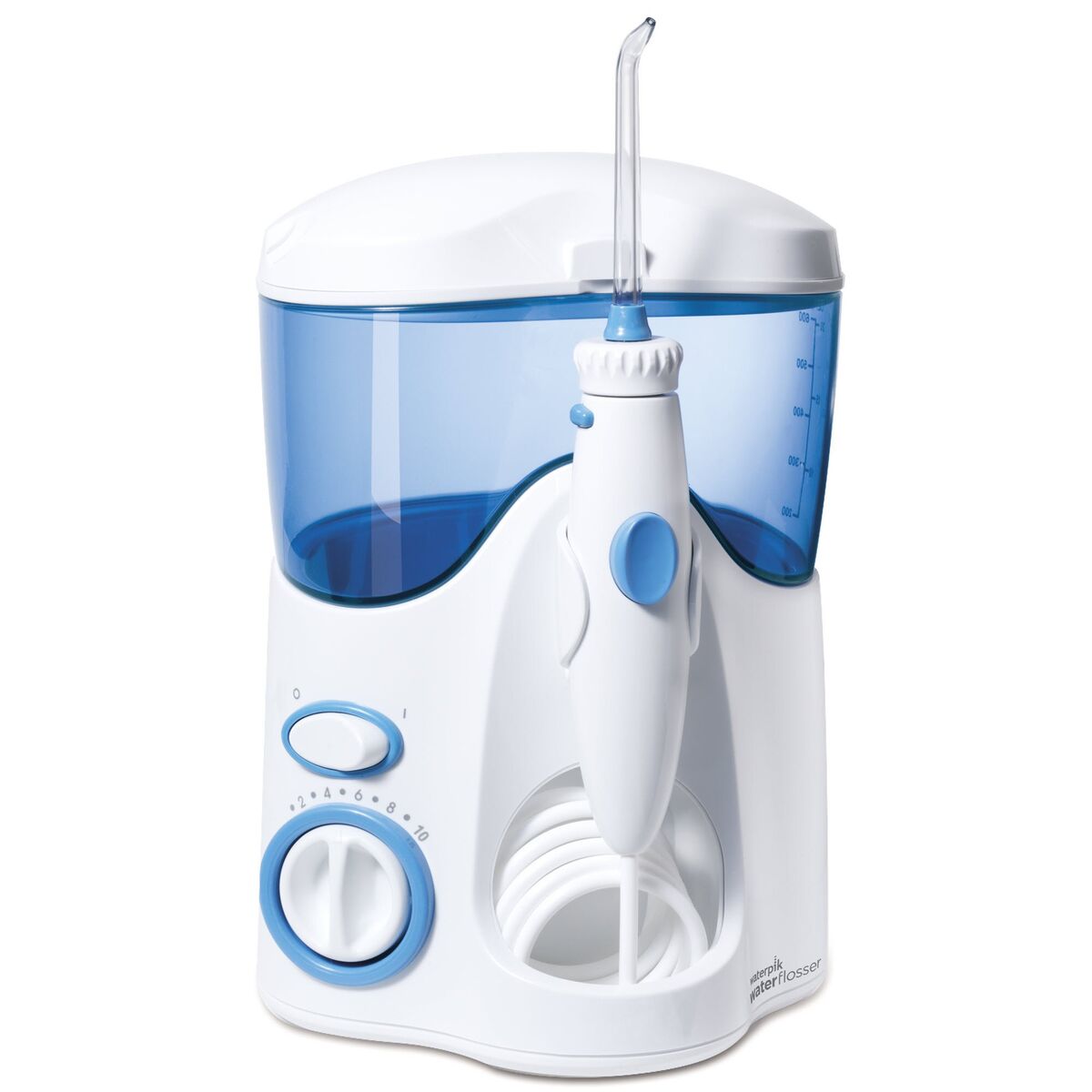
The WP-100 is a countertop (corded) water flosser designed for home use. Its specifications position it as a mid-to-upper-tier model in Waterpik's lineup, offering a strong balance of performance, capacity, and value.
| Specification | Detail |
|---|---|
| Type | Countertop (AC powered) |
| Reservoir Capacity | 650 mL (22 oz) -- approximately 90+ seconds of use |
| Pressure Settings | 10 settings (10-100 PSI) |
| Pulses Per Minute | 1,400 |
| Included Tips | 6 tips (2 Classic Jet, 1 Orthodontic, 1 Plaque Seeker, 1 Pik Pocket, 1 Toothbrush) |
| Tip Storage | Built-in tip storage compartment on unit |
| Handle Control | On/off water flow switch on handle |
| Tip Rotation | 360-degree swivel |
| Dimensions | Approximately 4.7 x 3.8 x 10.3 inches |
| Weight | 1.46 lbs (unit only) |
| Warranty | 2 years (manufacturer) |
| Retail Price (2026) | $55 - $75 |
Included Tips and What Each One Does
One of the WP-100's greatest strengths is its versatility, driven by the six included tips. Each tip is color-coded so multiple family members can use the same unit with their own designated tip.
- Classic Jet Tip (x2): The standard tip for general interdental cleaning and gumline irrigation. Suitable for most users and the best starting point for new water flosser users.
- Orthodontic Tip: Features a small brush at the end of the tip that combines water flow with gentle bristle contact. Designed specifically for cleaning around braces, brackets, wires, and other fixed orthodontic appliances. Clinically proven to be 3x more effective than string floss for patients with braces.
- Plaque Seeker Tip: Has three thin tufts of bristles that work with the water stream to target and break up stubborn plaque deposits. Ideal for use around crowns, bridges, dental implants, and other restorations where plaque tends to accumulate at the margins.
- Pik Pocket Tip: A specialty tip with a soft, flexible rubber cone designed to deliver water or medicaments deep into periodontal pockets. Intended for patients with moderate to advanced gum disease, under the guidance of a dental professional. Effective at delivering antimicrobial rinses below the gumline.
- Toothbrush Tip: Combines a small brush head with the water flosser stream, allowing you to brush and irrigate simultaneously. Useful as a supplemental brush for hard-to-reach areas but not intended to replace your primary toothbrush.
Tip Replacement Schedule
Waterpik recommends replacing the Classic Jet Tip every 6 months and all specialty tips (Orthodontic, Plaque Seeker, Pik Pocket, Toothbrush) every 3 months. The bristles on specialty tips degrade with use and become less effective at disrupting plaque biofilm. Replacement tips cost approximately $5 to $10 each and are widely available online and in stores.
Step-by-Step Usage Guide for Maximum Effectiveness
Getting the most from your Waterpik WP-100 requires proper technique. Follow these steps for optimal results.
- Fill the reservoir with lukewarm water (not hot). You can add a small amount of non-alcohol-based mouthwash for additional freshness, but this is optional.
- Select and insert your tip by pressing it firmly into the handle until it clicks into place.
- Set the pressure dial to the lowest setting (especially if you are a first-time user or have sensitive gums). You can gradually increase pressure over the first week as your gums adjust.
- Lean over the sink and place the tip in your mouth before turning the unit on. This prevents water from spraying before you are ready.
- Close your lips slightly around the tip to prevent splashing while allowing water to flow freely from your mouth into the sink.
- Aim the stream at the gumline at a 90-degree angle. Start at the back molars on one side and work your way around to the other side, pausing briefly at each interproximal space (between teeth). Trace the gumline on both the cheek-side and tongue-side surfaces.
- Spend approximately 60 to 90 seconds completing the full mouth. The 650 mL reservoir provides enough water for this duration without needing a refill.
- Turn the unit off before removing the tip from your mouth to avoid splashing. Empty any remaining water from the reservoir and leave the lid open to air-dry.
Important: Water Flossing Does Not Replace Brushing
A water flosser is an interdental cleaning tool. It supplements your toothbrush -- it does not replace it. The recommended oral hygiene routine is: brush for two minutes twice daily with a fluoride toothpaste, then water floss once daily (ideally before bed). Some dental professionals recommend water flossing before brushing so that the fluoride in your toothpaste can penetrate the newly cleaned interproximal surfaces.
In-Depth Performance Review: Strengths and Weaknesses
After four weeks of daily testing, here is our honest assessment of the Waterpik Ultra WP-100.
What We Loved
- Exceptional Cleaning Power: The combination of 1,400 pulses per minute and adjustable pressure from 10 to 100 PSI delivers a thorough clean that you can feel immediately. Gums felt noticeably healthier within the first week, and a dental checkup at the four-week mark confirmed measurable improvement in gum bleeding scores.
- Versatile Tip Selection: The six included tips mean the WP-100 can serve an entire household. The Orthodontic tip performed exceptionally well around brackets, and the Plaque Seeker tip was outstanding for cleaning around implant abutments.
- Large Reservoir: At 650 mL, the reservoir provides enough water for a full 90-second session without interruption -- a notable advantage over cordless models with 200-300 mL tanks that require mid-session refills.
- Handle-Mounted Flow Control: The pause/play button on the handle lets you stop the water stream instantly without reaching for the base unit. This simple feature dramatically reduces mess during use.
- Price-to-Performance Ratio: At $55 to $75, the WP-100 delivers countertop-grade performance at a price point that undercuts many competitors offering fewer features.
Where It Falls Short
- Countertop Footprint: The unit requires a dedicated spot near an electrical outlet. If your bathroom counter space is limited, this can be a challenge. The dimensions (approximately 4.7 x 3.8 x 10.3 inches) are not excessive, but it is not a device you can tuck away in a drawer.
- Noise Level: Like all countertop water flossers, the WP-100 generates noticeable motor noise during operation. It is roughly comparable to an electric toothbrush at its loudest -- not disruptive, but not silent either. Not ideal for early-morning or late-night use in shared living spaces.
- Not Travel-Friendly: The corded design and reservoir size make it impractical for travel. Frequent travelers will need a separate cordless model for on-the-go use.
- Learning Curve for New Users: First-time water flosser users will likely splash water everywhere during their first few sessions. The technique of closing your lips around the tip while leaning over the sink takes a few tries to master.
WP-100 vs. Competing Water Flossers in 2026
The water flosser market has expanded significantly. Here is how the WP-100 compares to its most relevant competitors in 2026.
| Model | Type | Reservoir | Pressure Settings | Tips Included | Price (2026) |
|---|---|---|---|---|---|
| Waterpik Ultra WP-100 | Countertop | 650 mL | 10 (10-100 PSI) | 6 | $55-$75 |
| Waterpik Aquarius WP-660 | Countertop | 650 mL | 10 (10-100 PSI) | 7 | $65-$90 |
| Waterpik Cordless Advanced WP-580 | Cordless | 207 mL | 3 | 4 | $60-$80 |
| Philips Sonicare Power Flosser 3000 | Cordless | 250 mL | 3 | 2 | $70-$100 |
| Oral-B Water Flosser Advanced | Countertop | 600 mL | 5 | 4 | $55-$70 |
| Bitvae C2 Water Flosser | Countertop | 800 mL | 5 | 6 | $30-$40 |
The WP-100 occupies a strong middle ground: it matches the Aquarius WP-660 in reservoir size and pressure range at a lower price point, while offering far more power and capacity than any cordless model. Budget brands like Bitvae undercut it on price but lack the ADA Seal of Acceptance, the decades of clinical research backing, and the build quality that Waterpik delivers.
"In our testing, the Waterpik Ultra WP-100 delivered performance nearly identical to the more expensive Aquarius WP-660 for daily interdental cleaning. The Aquarius adds a floss mode and a slightly more modern design, but the core cleaning experience is the same." -- Dental Product Shopper, 2025 Independent Review
Who Should Buy the Waterpik Ultra WP-100?
The WP-100 is the right choice for specific patient profiles. Here is who will benefit most.
- Orthodontic patients: Anyone with braces, permanent retainers, or lingual wires will find the Orthodontic Tip indispensable for cleaning areas that string floss simply cannot access.
- Implant, bridge, and crown patients: The Plaque Seeker Tip is specifically designed to clean around restorative margins where plaque buildup can lead to peri-implantitis or secondary decay.
- Patients with gum disease: The adjustable pressure settings and Pik Pocket Tip allow gentle sub-gingival irrigation that is difficult or impossible with traditional floss.
- Patients with dexterity limitations: Arthritis, carpal tunnel, or any condition that makes manipulating string floss difficult makes water flossing the superior alternative.
- Families: The six color-coded tips and durable countertop design make this a practical shared device for households with multiple users.
Who Should Consider a Different Model?
If you travel frequently and need to water floss on the road, consider a cordless model like the Waterpik Cordless Advanced WP-580. If you want a smaller countertop footprint, the Waterpik Sonic Fusion 2.0 combines a sonic toothbrush and water flosser in one device. If budget is your primary concern and you are comfortable with a less-proven brand, models from Bitvae or Nicwell offer functional water flossing at lower price points.
Maintenance, Cleaning, and Longevity Tips
A well-maintained Waterpik WP-100 should last three to five years or more. Follow these maintenance practices to maximize its lifespan.
- Empty the reservoir after each use and leave the lid open to allow it to air-dry. Standing water promotes bacterial and mold growth inside the reservoir.
- Clean the reservoir weekly with warm soapy water or a 50/50 solution of white vinegar and water. Rinse thoroughly before the next use.
- Descale the internal plumbing monthly in areas with hard water. Fill the reservoir with a mixture of two tablespoons of white vinegar and warm water, run the unit until the reservoir is empty, then run a full reservoir of clean water to rinse.
- Replace tips on schedule: Classic tips every 6 months, specialty tips every 3 months. A worn tip delivers less effective cleaning.
- Wipe down the exterior of the unit weekly to prevent buildup of water spots and residue.
- Never submerge the base unit in water. It contains the motor and electrical components. Wipe it with a damp cloth only.
Sources
- American Dental Association -- ADA Seal Product Report: Waterpik Water Flossers, 2025
- Journal of Clinical Dentistry -- Efficacy of Water Flossing vs. String Floss: A Systematic Review, 2024
- American Dental Hygienists' Association -- Position Paper on Interdental Cleaning Devices, 2025
- Dental Product Shopper -- Independent Water Flosser Comparison Review, 2025
- Journal of Periodontology -- Water Irrigation as an Adjunct to Scaling and Root Planing: Clinical Outcomes, 2025
FAQ: Waterpik Ultra WP-100
For most people, yes. Clinical studies consistently show that water flossing is equal to or more effective than string floss at reducing plaque, gingivitis, and bleeding on probing. The ADA has recognized Waterpik water flossers as an effective alternative to string floss. That said, some dental professionals still recommend occasional use of string floss to physically scrape the proximal surfaces of teeth where tight contacts exist, as the water stream cannot replicate this mechanical scraping action. The bottom line: a Waterpik used daily is far better than string floss that sits unused in a drawer.
You can add a small amount of non-alcohol-based, non-staining mouthwash (such as a mild fluoride rinse or chlorhexidine if prescribed by your dentist) to lukewarm water in the reservoir. A warm saltwater solution is also safe and can be soothing for inflamed gums. However, always run a full reservoir of plain water through the unit afterward to prevent residue from building up in the internal tubing. Avoid using essential oils, hydrogen peroxide at high concentrations, or any thick or colored liquids that could stain or damage the unit.
Yes, and in fact it is highly recommended. Dental implants are susceptible to a condition called peri-implantitis -- inflammation and bone loss around the implant caused by bacterial plaque. The Plaque Seeker Tip is specifically designed to clean around implant abutments and crown margins where plaque tends to accumulate. Studies show that water flossing around implants reduces bleeding, probing depth, and inflammatory markers compared to manual brushing alone. Start at a lower pressure setting and use the Plaque Seeker Tip for best results.
Research suggests that water flossing before brushing may be slightly more beneficial. A 2019 study in the Journal of Periodontology found that flossing before brushing resulted in significantly greater fluoride retention in the interproximal areas compared to brushing first. The logic is simple: water flossing removes debris and disrupts plaque between teeth, and the subsequent brushing with fluoride toothpaste can then penetrate those freshly cleaned surfaces more effectively. That said, the most important factor is consistency -- water floss at whatever point in your routine ensures you will actually do it every day.
Both models share the same 650 mL reservoir, 10 pressure settings, and 1,400 pulses-per-minute motor. The Aquarius WP-660 adds a dedicated "Floss Mode" (a brief pause-pulse pattern designed to mimic the feeling of traditional flossing), an LED pressure indicator on the handle, one additional tip (7 vs. 6), and a slightly more modern design aesthetic. In our testing, the actual cleaning performance was virtually identical. If the floss mode and LED indicator appeal to you and you are willing to pay $10 to $20 more, the Aquarius is a modest upgrade. Otherwise, the WP-100 delivers the same results for less money.